Posts filed under Pen Reviews

Morning Glory Mach Campus 0.28 mm Review

(Jeff Abbott is a regular contributor at The Pen Addict. You can find more from Jeff online at Draft Evolution and Twitter.)

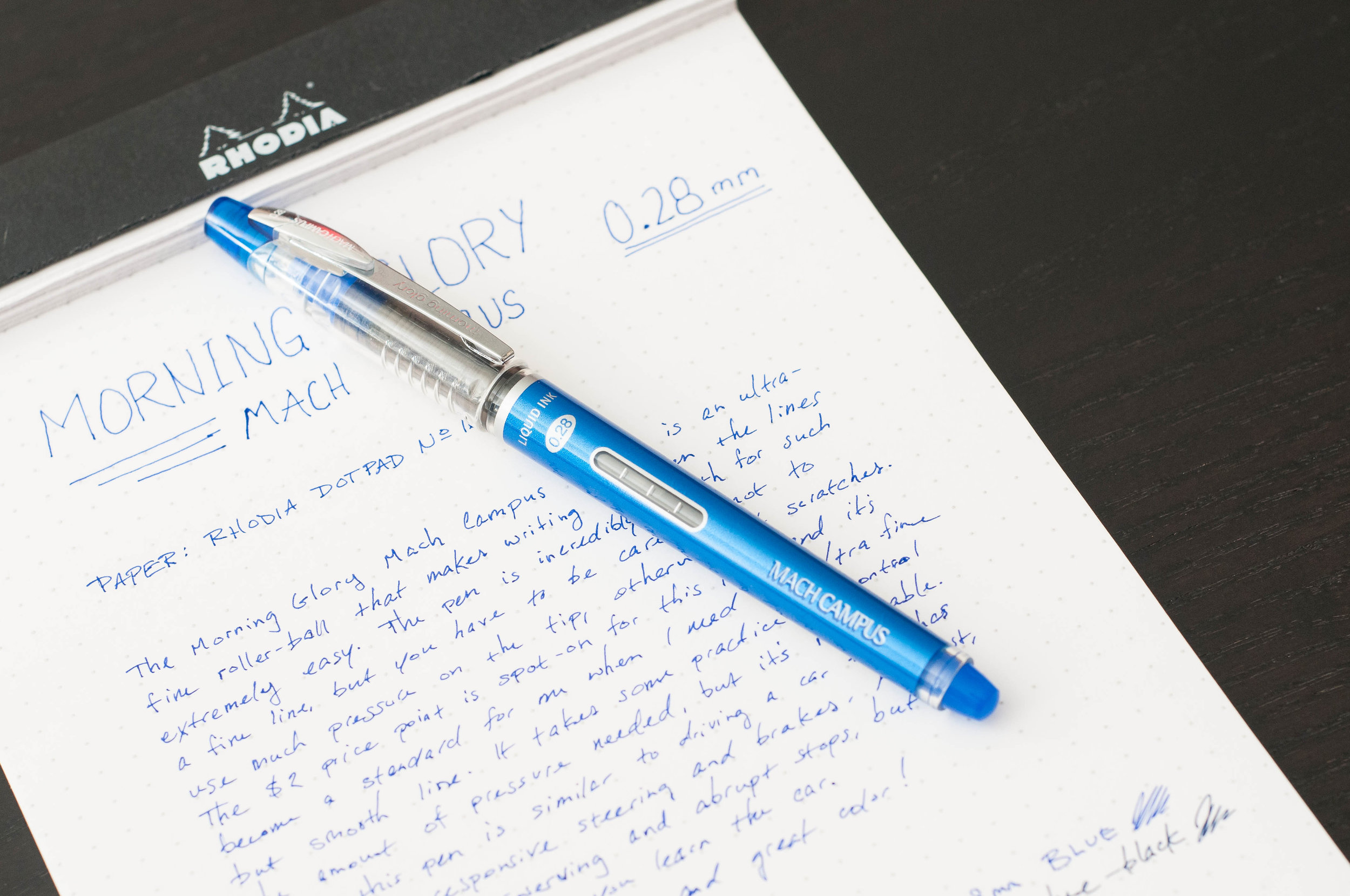
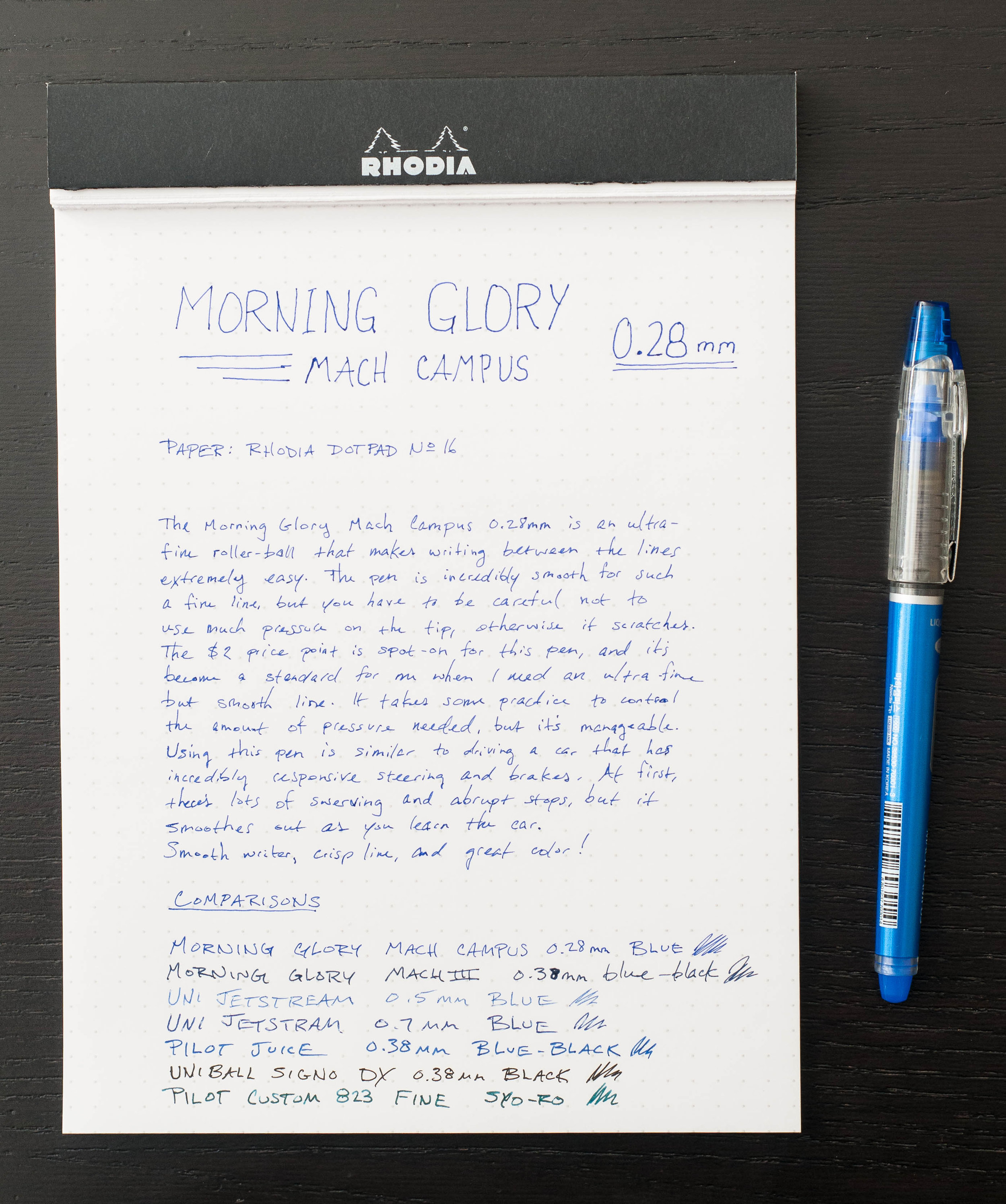
Ultra-fine point gel pens are pretty common and accessible today. While I typically don't drop down below a 0.38mm point myself, it is fun to try out the micro points that are available today. And while these are fairly prevalent in the gel pen category, the same isn't true for the rollerball category. A few years back, a new player in the rollerball game was introduced: the Morning Glory Mach 3 line with their 0.38mm tips and fun colors. These are fun pens in their own way, but the Mach Campus is the same pen taken a bit further. At 0.28mm, it's definitely the smallest rollerball I've used. And, as long as you're careful with the amount of pressure you use when writing, it's a smooth, fine line.

I'm not sure how long the Mach Campus line has been around, but it's generally the same pen as the Mach 3, minus the large array of color options. The Mach Campus has several fun body colors to choose from, but just the standard black, blue, and red ink colors. Like the Mach 3 line (which is all 0.38mm), the Mach Campus line is entirely 0.28mm. These rollerballs are for those of you who want a small, crisp line out of your pen.

Apart from the name on the side of the barrel, it's hard to distinguish these two pens. But, you can definitely tell which is which once you start writing. The 0.38mm version is much more forgiving than the 0.28mm version when it comes to smoothness and scratching the paper. The 0.38mm glides effortlessly on smooth paper, and has occasional issues on rougher papers. The same isn't true of the 0.28mm — you have to be more mindful of the pressure you use when using this pen. If you use a light touch when writing, it's a smooth writer — it definitely doesn't feel like a 0.28mm point, that's for sure. But, if you press down too hard, the pen will feel scratchy, and in the worst case, it will also tear or cut the paper.

After a bit of practice, I easily grew accustomed to this pen and found it really enjoyable to write with. That being said, I only wrote in small characters instead of my normal size handwriting. There's something about a point this small that just makes it difficult for me to use normal-sized characters. I don't think that's due to pen, but more my sub-conscious.

One of the best features of both lines from Morning Glory is the ink. It's dark, smooth, easy-flowing, and reliable. The edges of the line remain sharp provided you are using decent paper that doesn't promote bleeding. The blue is on the darker side, but has a rich, interesting color that jumps off the paper due to the crisp edges. When I look at a page that's been written with this pen, it reminds of looking at a Retina display for the first time. Super sharp!

The grip on the Mach Campus, like its cousin, is textured and comfortable when writing. The entire pen is plastic and disposable, but it feels well made and sturdy. At just under $2.00, it's a great deal for a disposable pen. I really wish they offered refillable versions with higher grade bodies, but these do just fine as-is.

There is a lot of text and branding printed on the body and cap of this pen, but it's as subtle as can be given the amount that's crammed in. This is fairly common for the price range, and it doesn't bother me. That being said, it doesn't really give off an executive vibe.

Overall, the Mach Campus by Morning Glory is a fantastic micro-rollerball that performs extremely well. It's an incredibly fine line, but still manages to be a smooth writer as long as you remember to use light pressure when writing. For the price, just throw a couple in your cart the next time you place an order. These pens are fun and useful to keep on hand.

(JetPens provided this product at no charge to The Pen Addict for review purposes.)


Enjoy reading The Pen Addict? Then consider becoming a member to receive additional weekly content, giveaways, and discounts in The Pen Addict shop. Plus, you support me and the site directly, which I am very grateful for.

Membership starts at just $5/month, with a discounted annual option available. To find out more about membership click here and join us!
Posted on May 17, 2017 and filed under Morning Glory, Pen Reviews.

Nemosine Singularity Aqua Demonstrator Fountain Pen Review

(Jeff Abbott is a regular contributor at The Pen Addict. You can find more from Jeff online at Draft Evolution and Twitter.)

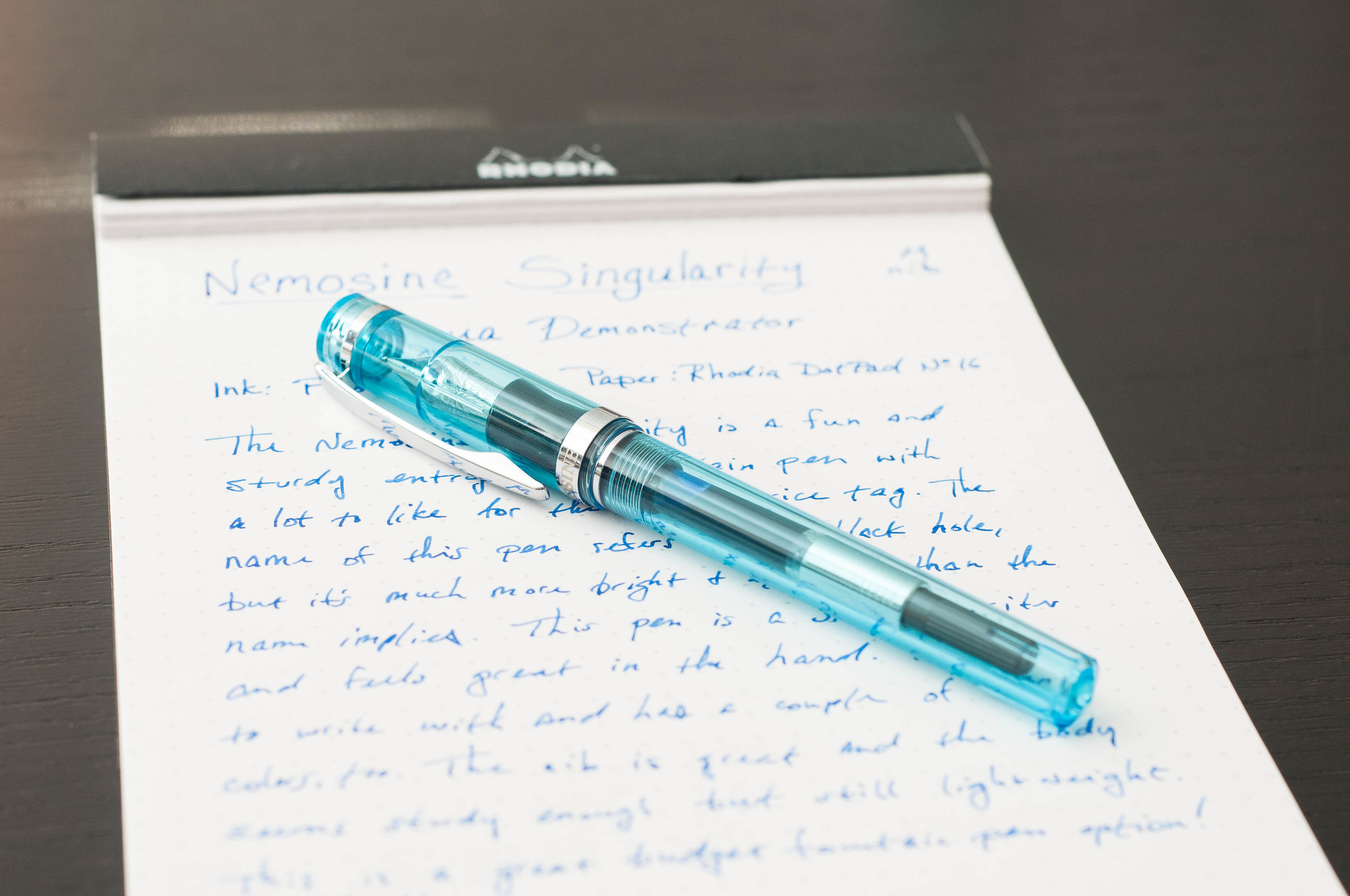
The Nemosine Singularity is an entry-level fountain pen from a new (to me, anyway) pen company that has a lot going for it. It's not often that we see newcomers to the entry-level game, so this is always exciting. But, it's also difficult to break into this level of fountain pen due to the excellent options already available.

The Nemosine Singularity is just a hair under $20 on JetPens, and you have a fairly good range of options between color and nib size (including an intriguing 0.6mm stub option). While the "gift box" aspect of this pen is a joke, the rest of the pen holds up well against expectations.

On first unboxing this pen, I had similar thoughts and assumptions as when I've purchased $6 fountain pens on eBay from a Chinese manufacturer. There's no flash or pizzazz in the packaging, and the experience is fairly boring. That's fine as long as the pen lives up to the unbelievable price. In the case of the Singularity, the presentation should be improved upon due to the surprisingly great quality of the pen.

This pen reminds me a lot of the Monteverde Artista. While it looks like that pen is being retired from JetPens, it is a great all-round pen for general writing. The Singularity is cheaper, has more nib options, and performs very closely with the Monteverde. I was impressed when I first tried it out.

At $20, you're up against a couple of the best budget fountain pens out there: the Pilot Metropolitan and Kakuno. After the $30 mark, you're in Kaweco, Lamy, and TWSBI territory, so let's leave them out for now. When you compare the Metropolitan and Singularity, the features are very similar. They both come with converters and cartridges, and they're only $5 apart. When comparing these, it really comes down to your own preference. Do you want a professional pen with classy accents? The Metropolitan is the best choice. Do you like how demonstrators look, or do you prefer plastic-body pens? The Singularity is a better option.

The build quality of the Singularity is better than I expected. While it's lightweight, it doesn't feel cheap or fragile. This pen can deal with some abuse, although it will show scratches. The clip has moderate strength and the threads feel precise and well-made.

Moving on to the grip and nib, it keeps impressing. The grip is a black plastic, and it fits my hand perfectly. This combined with the light weight make it ideal for longer writing sessions. The particular model I have uses the medium nib, and it writes like a dream. It's a bit on the wet side, but that's something I expect and want from a medium nib. It never stutters, skips, or has a hard time starting, and it's as smooth as can be. It's a steel nib, but it has a good amount of flexibility that can provide some minimal variation with the right pressure applied.

I'm not sure where the nibs are sourced, but they do say "Made in Germany" on the bottom. Also, the decoration on the nib is classy and pleasing. It's not a plain nib, but it isn't chintzy either.

The included converter does feel cheaper than the pen, but it's worked great so far. One minor complaint I have about this converter is that it has a small ball inside to keep the ink moving around. Other converters use this same method, and the noise that the ball makes inside the converter when you move the pen around has always bothered me. I'm not sure why it's there when other converters do just fine without it. Like I said, it's a minor niggle.

Overall, I've been really impressed by this budget newcomer. It feels well-built while also remaining light, it writes like a dream, and it costs less than $20 (barely). I can see this being a perfect recommendation for people who want to spend 20 bucks on their first demonstrator. For me, it will be a common tester pen for different inks since the nib performs so well.

The Nemosine Singularity is available in Onyx, Aqua, Azalea, and Demonstrator colors from JetPens. You also have an option of EF, F, M, B, and 0.6mm stub nibs. The stub looks particularly interesting!

(JetPens provided this product at no charge to The Pen Addict for review purposes.)


Enjoy reading The Pen Addict? Then consider becoming a member to receive additional weekly content, giveaways, and discounts in The Pen Addict shop. Plus, you support me and the site directly, which I am very grateful for.

Membership starts at just $5/month, with a discounted annual option available. To find out more about membership click here and join us!

Posted on May 10, 2017 and filed under Nemosine, Fountain Pens, Pen Reviews.

Benu Purple Night Silver Fountain Pen: A Review

(Susan M. Pigott is a fountain pen collector, pen and paperholic, photographer, and professor. You can find more from Susan on her blog Scribalishess.)

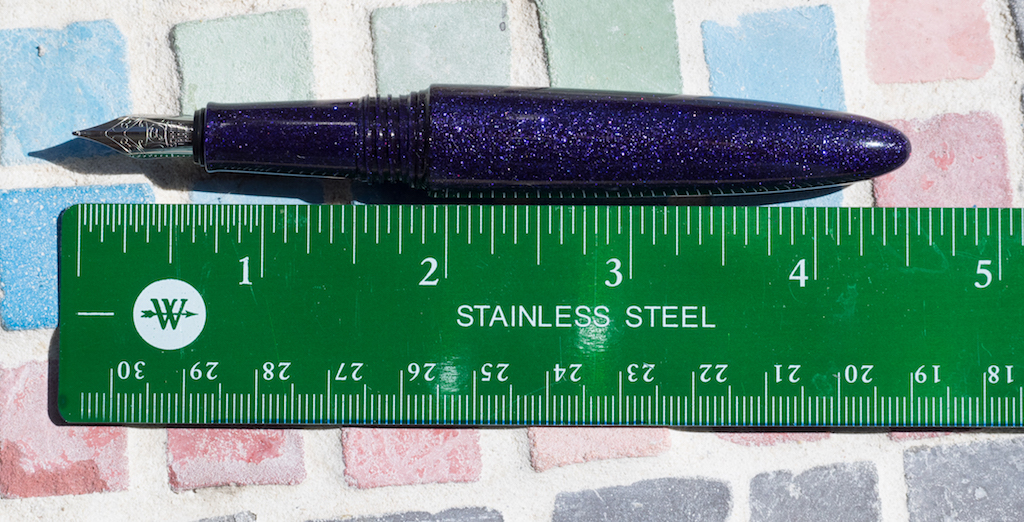
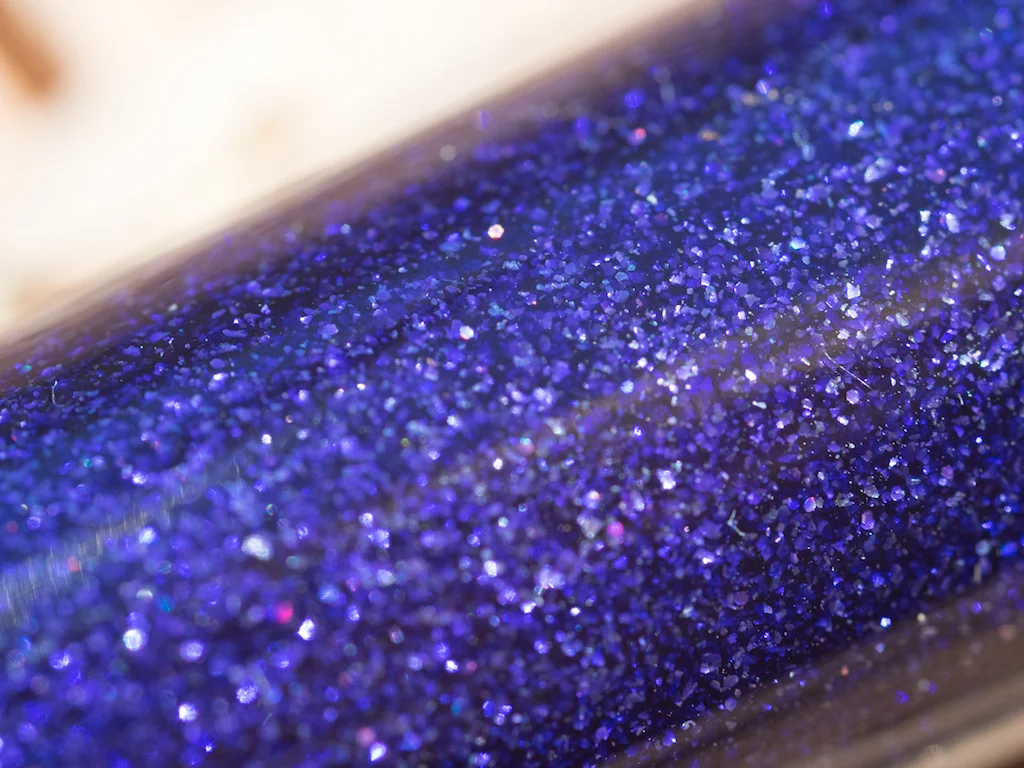
Benu is a Russian pen company that produces fountain pens and ball point pens in various handmade resins. They currently offer pens in three collections: Classic, Ornate, and Sublime. The pen I’m reviewing is from the Classic Collection and is called “Purple Night Silver.” It features aventurescent (sparkly) resin with a rhodium plated brass ring.

The Benu pen comes in a black cardboard box with the Benu name on top. Inside, you’ll find the pen wrapped in Benu paper tied with twine and nestled in shredded brown paper. The paper wrap includes information about your pen.

The pen is torpedo shaped and the only complication in the design is the rhodium-plated ring with the name Benu inscribed. There is no clip.

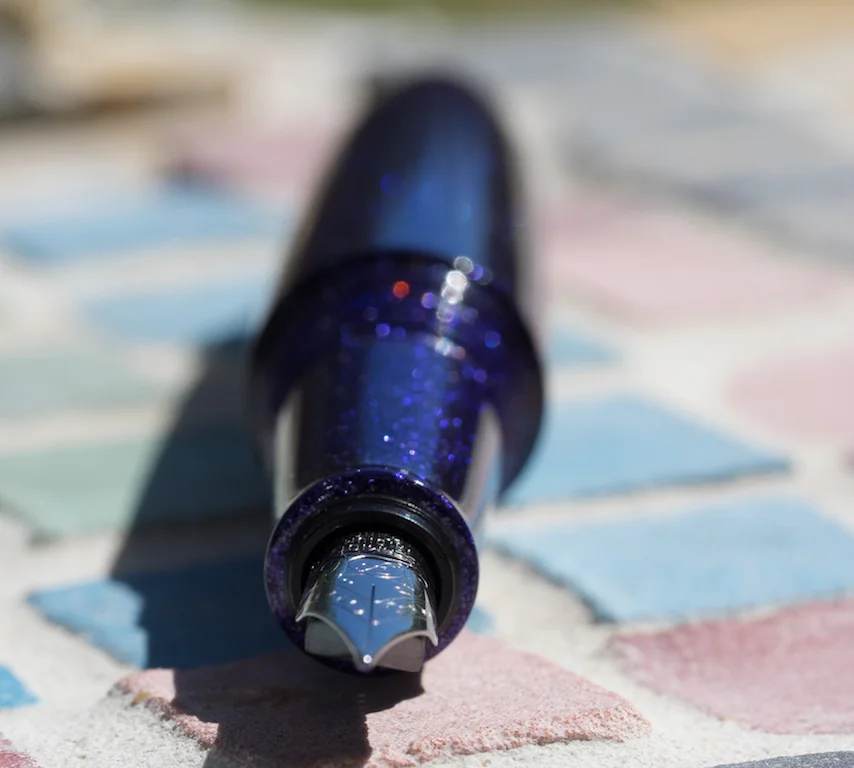
When you unscrew the cap, you’ll notice a sharp stepdown from the barrel to the grip, but the grip area is long, and the thickest part of the barrel rests between your index finger and thumb. So, the pen is quite comfortable to hold, and the barrel threads are far enough back that your fingers won’t contact them.

The nib is a Schmidt stainless steel fine (medium and broad are also available). It has some scrollwork, and the nib size is engraved in the middle along with “Schmidt Iridium Point.”

This is a tiny nib because the Benu is a small pen weighing only 0.7 ounces. Capped, the pen is 4.9 inches. Uncapped it is 4.5 inches, and you cannot post the cap.

Currently all Benu pens are cartridge only, but a representative told me they are manufacturing a new pen that will take a converter. My review model came with a Schneider standard short international size cartridge with blue ink.

The Benu pen writes beautifully. The fine steel nib is smooth and demonstrates no hard starts or skipping. I find it a comfortable writer overall.

My main complaints about the pen are (1) the pen is so light that it feels cheap. The resin is unique and thick, but you can definitely tell this pen is plastic. And although it is handmade, it doesn’t have the feel of a Shawn Newton or Scriptorium pen, though, admittedly, those pens are much more expensive. (2) The threads on my pen are rough and sometimes it takes a few tries to get the cap to screw on correctly. (3) For a pen like this I would expect to pay around $40 or so, especially since it is cartridge only and lacks any complicated design elements. But it costs $90. That said, I have no idea how much it costs to make handmade resin and to manufacture pens for export from Russia.

I really like all the different resins Benu Pens offers. They have many beautiful, unique choices. You can purchase Benu pens from their website: BenuPen.com. Models range from $80-$120.

Pros

  • The sparkly purple resin on my pen is quite striking, especially in sunlight.
  • The pen is comfortable to write with.
  • Because this pen is so small, it might work well as a pocket or a purse pen, though it does not come with a clip.
  • The Schmidt fine nib on my review model writes beautifully.
  • Benu offers a wide range of unique resin colors though all the pens have the same torpedo shape.

Cons

  • Unfortunately, the pen does not have that special feel that you might expect of a homemade pen.
  • The Benu is a good pen—one that I think many people would enjoy as a pocket or purse pen. However, as such, it seems overpriced.
  • The threads on my pen are rough and the cap doesn’t screw on smoothly.
  • The pen is cartridge only which limits your ink choices.
  • This pen is very light, so if you prefer hefty pens, you’ll need to look elsewhere.

(Benu Pens provided this pen at no cost to Pen Addict for review purposes.)


Enjoy reading The Pen Addict? Then consider becoming a member to receive additional weekly content, giveaways, and discounts in The Pen Addict shop. Plus, you support me and the site directly, which I am very grateful for.

Membership starts at just $5/month, with a discounted annual option available. To find out more about membership click here and join us!

Posted on May 5, 2017 and filed under Benu Pen, Fountain Pens, Pen Reviews.