Posts filed under Pen Reviews

Top 5 Pens, 2018 Edition

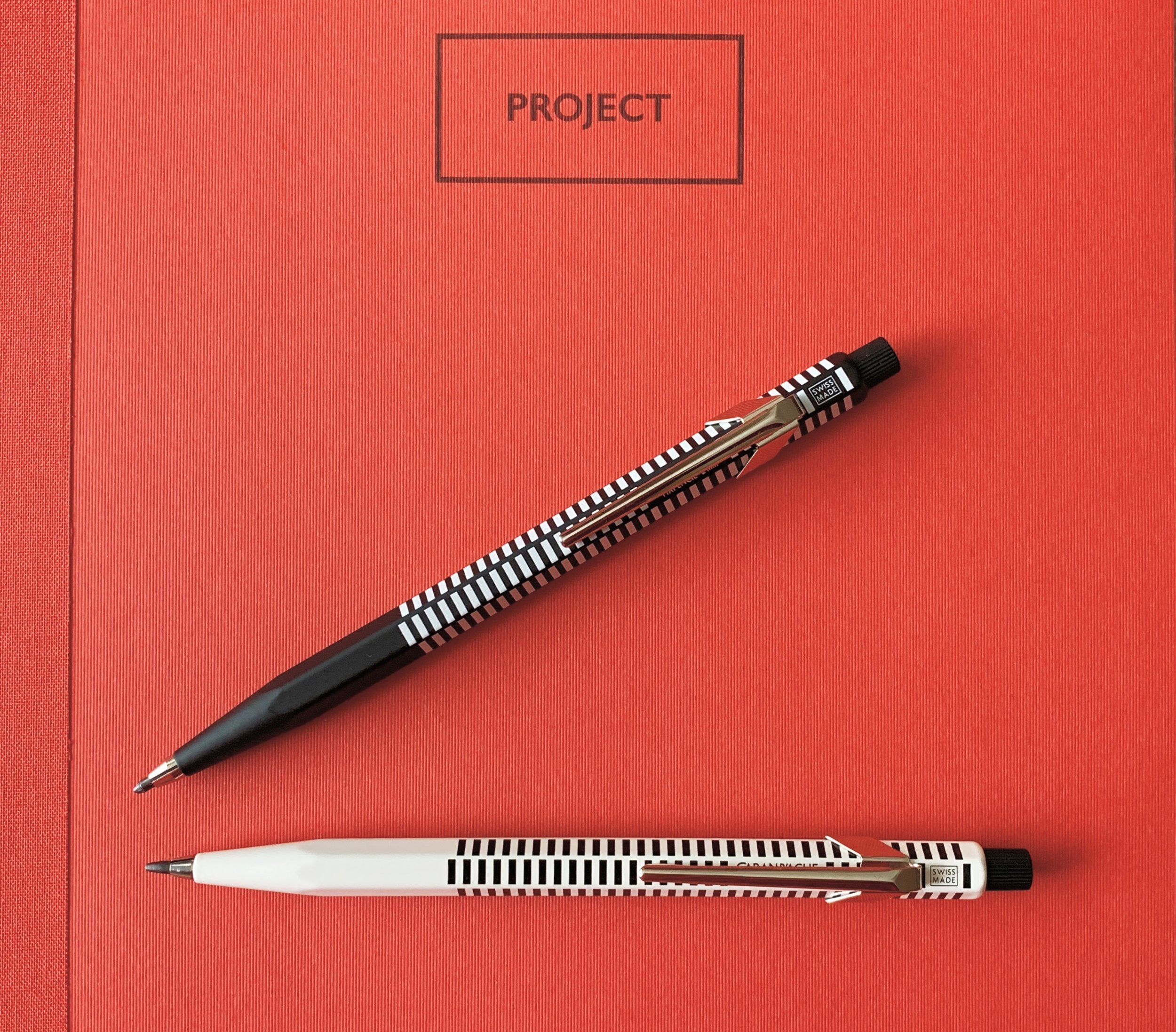
Where do I put my beloved Caran d’Ache Fixpencil?

I think we are there.

The 2017 version of my Top 5 Pens list was telling. It was the least amount of product turnover I have ever had on this list, and I think there is even less this year. While seeing movers and shakers all across the board may be more fun, I’m content in knowing that there are many quality products on the market that have withstood the test of time.

That doesn’t mean there are no changes or new additions on this list - there will always be movement in and out. What it does mean is that my confidence level is high on the products I do recommend. Like I just mentioned, time has a way of sorting these things out.

I’ll never make a change for changes sake. Products on this list are there because they deserve to be, not because I feel like shaking things up.

Keep this in mind while reading this list: It is based on what I would recommend. That may or may not be different than how I would rank them for my personal use. The Micro Gel ink pen category is the perfect example of this. The Pilot Hi-Tec-C 0.3 mm is number one for me, but number five on this list due to its particularness.

Two new, highly specific, lists have been added for Blue Black and Orange fountain pen inks. I’ve been asked to do these lists for a while, and since they are my two favorite ink colors, and I have experience with dozens of them, I feel good putting together five excellent ones of each shade.

Finally, before you head over and pick through the list, I have one product that I love that doesn’t have a home: The Caran d’Ache Fixpencil.

If I kept a daily usage log of all of the products I have used over the past year, I would wager that the Fixpencil would top the list. I love the design, the quality, and most importantly, the performance. It’s the portable pencil I need for the way I work. It goes everywhere with me.

But what list should it be on? It’s not a wooden pencil, that’s for sure. It’s sort of a mechanical pencil, but not in the traditional sense. It is a clutch pencil, with a 2.0 mm lead and a built in sharpener under the cap. I find it endlessly useful, and I don’t have a place to put it.

Because of this pencil, I’m looking at reviewing other clutch pencils and leadholders just so I have a list to put this one on. Do you have a favorite? I’m taking recommendations for spots two through five on the list, because nobody is going to top my number one!

As always, let me know your favorites that I am forgetting or that I need to take a further look at. Leave a comment on this post, or drop me a message on Twitter and Instagram.
Posted on November 5, 2018 and filed under Top 5, Pen Reviews.

Tombow Mono Edge Dual-tip Highlighter Review

(Jeff Abbott is a regular contributor at The Pen Addict. You can find more from Jeff online at Draft Evolution and Twitter.)

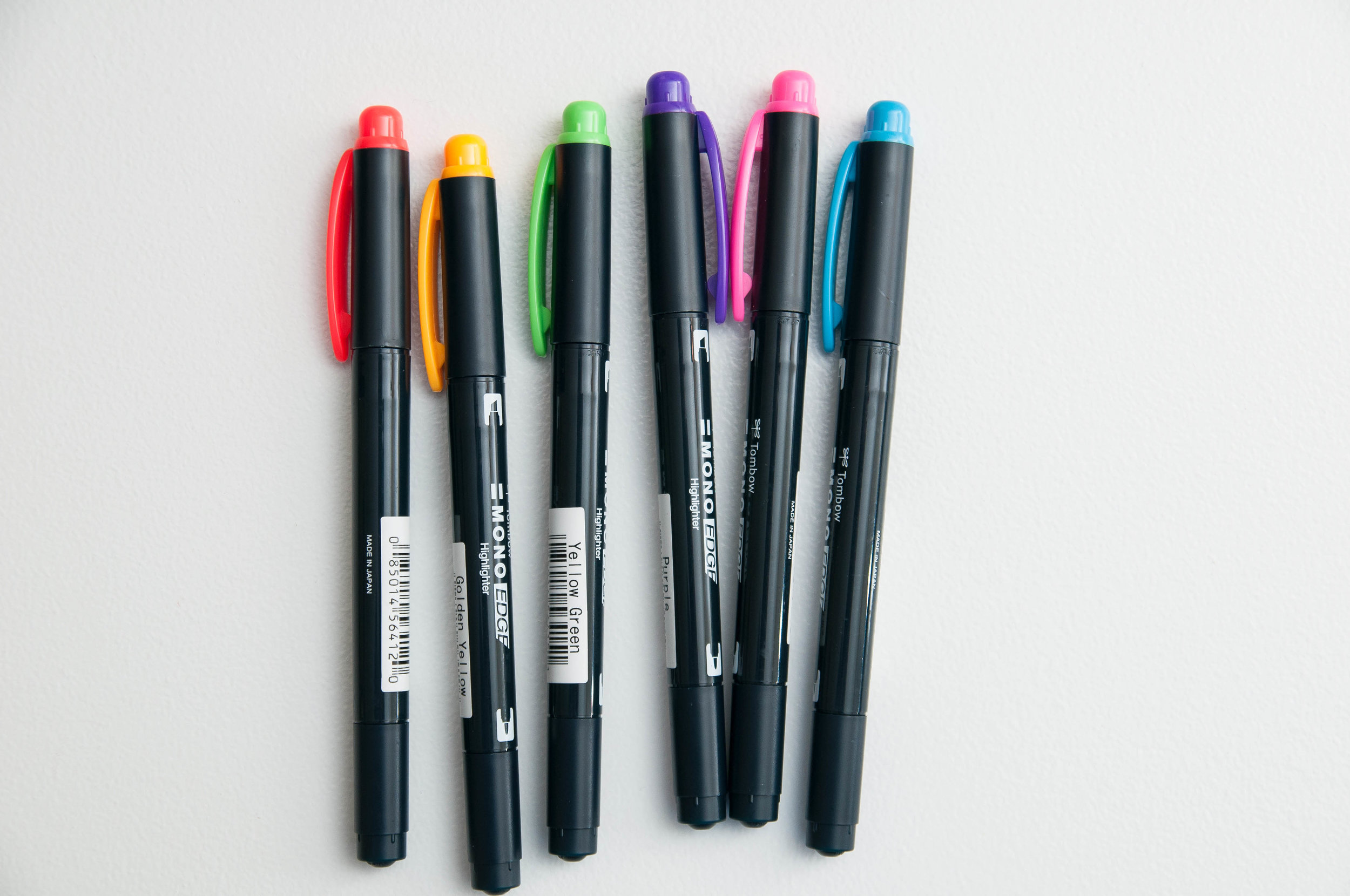
Highlighters may not be the most exciting category of stationery, but they're extremely helpful and useful tools. Like any tool, most people like to use the best ones available to them. With the Tombow Mono Edge dual-tip highlighters pack, your highlighting bases are covered.

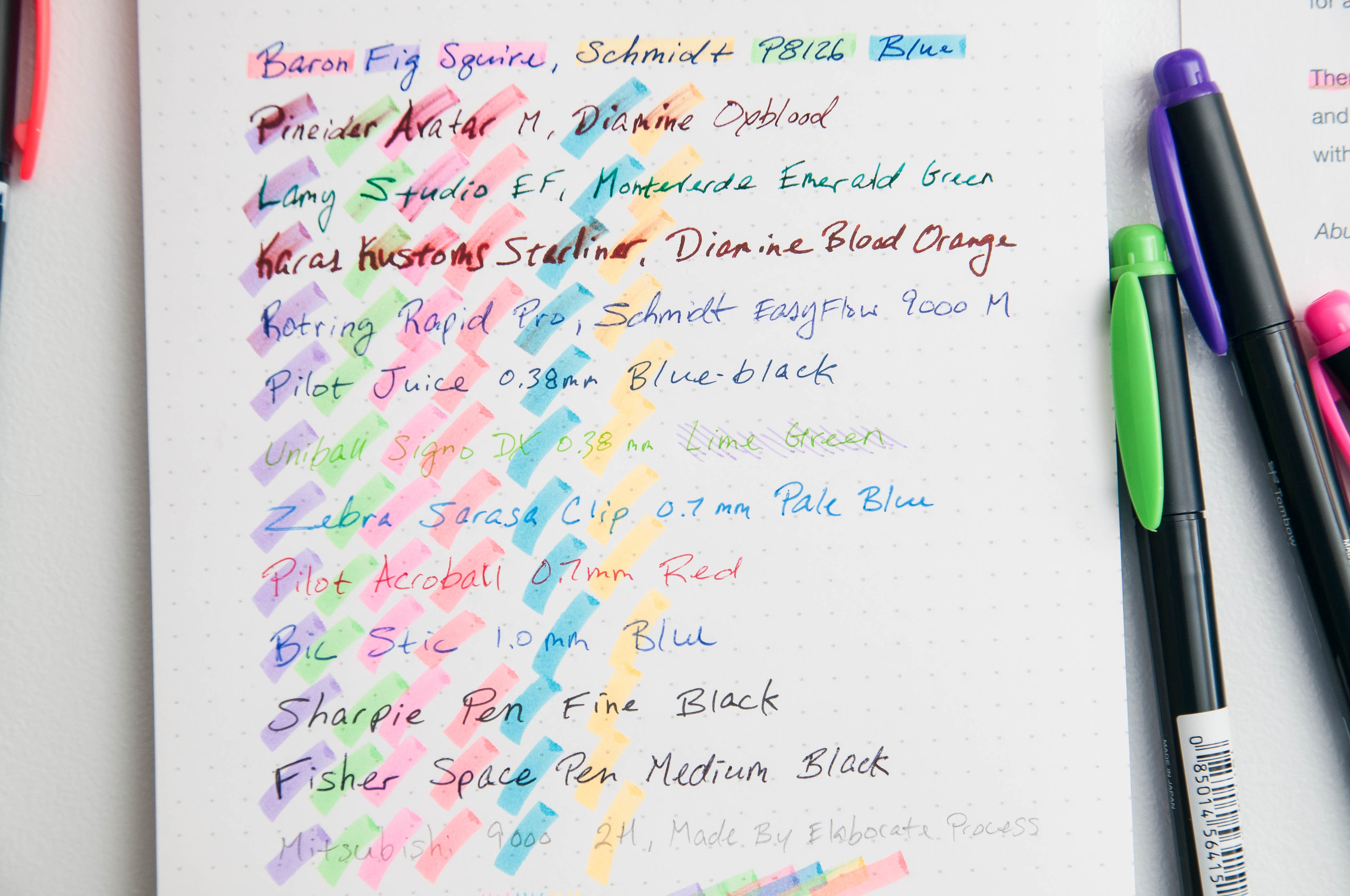
The Tombow Mono Edge pack contains six different highlighters that all pack two different tips on either end. In the set, you have a wide range of color options, from golden yellow, pink, purple, red, sky blue, and yellow green. These colors provide a lot of contrast when marking up pages, and they seem to play nicely with most inks (fountain pens excluded).

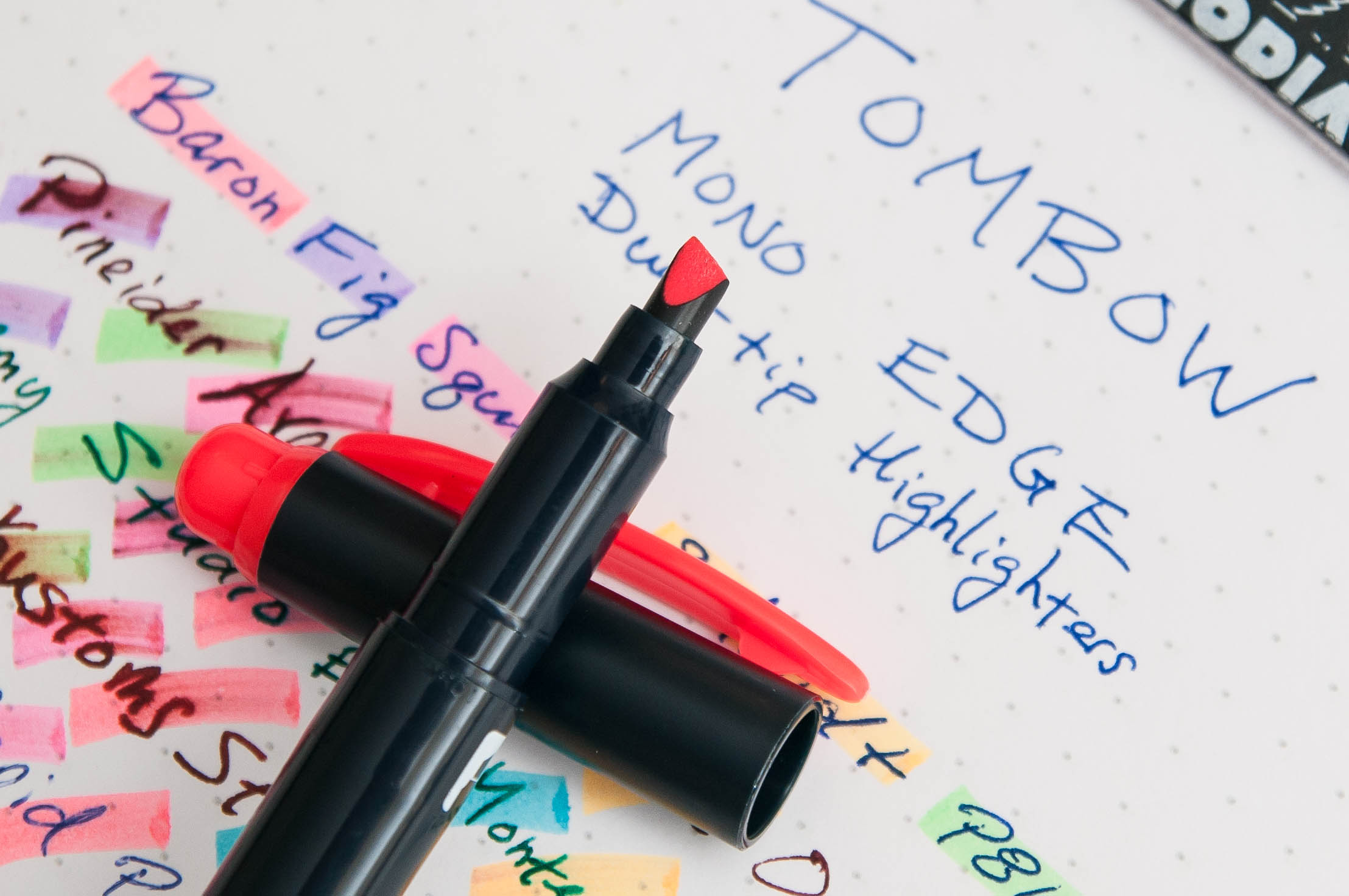
The main selling feature of these highlighters is the dual tip action. On the top of the pen, there's a cap with a clip that houses the larger of the two highlighter tips. This tip is about 4mm wide and has a nicely chiseled shape. You can also turn the tip on the end to get a fine line, and you can also orient the chisel sideways to draw a thinner line.

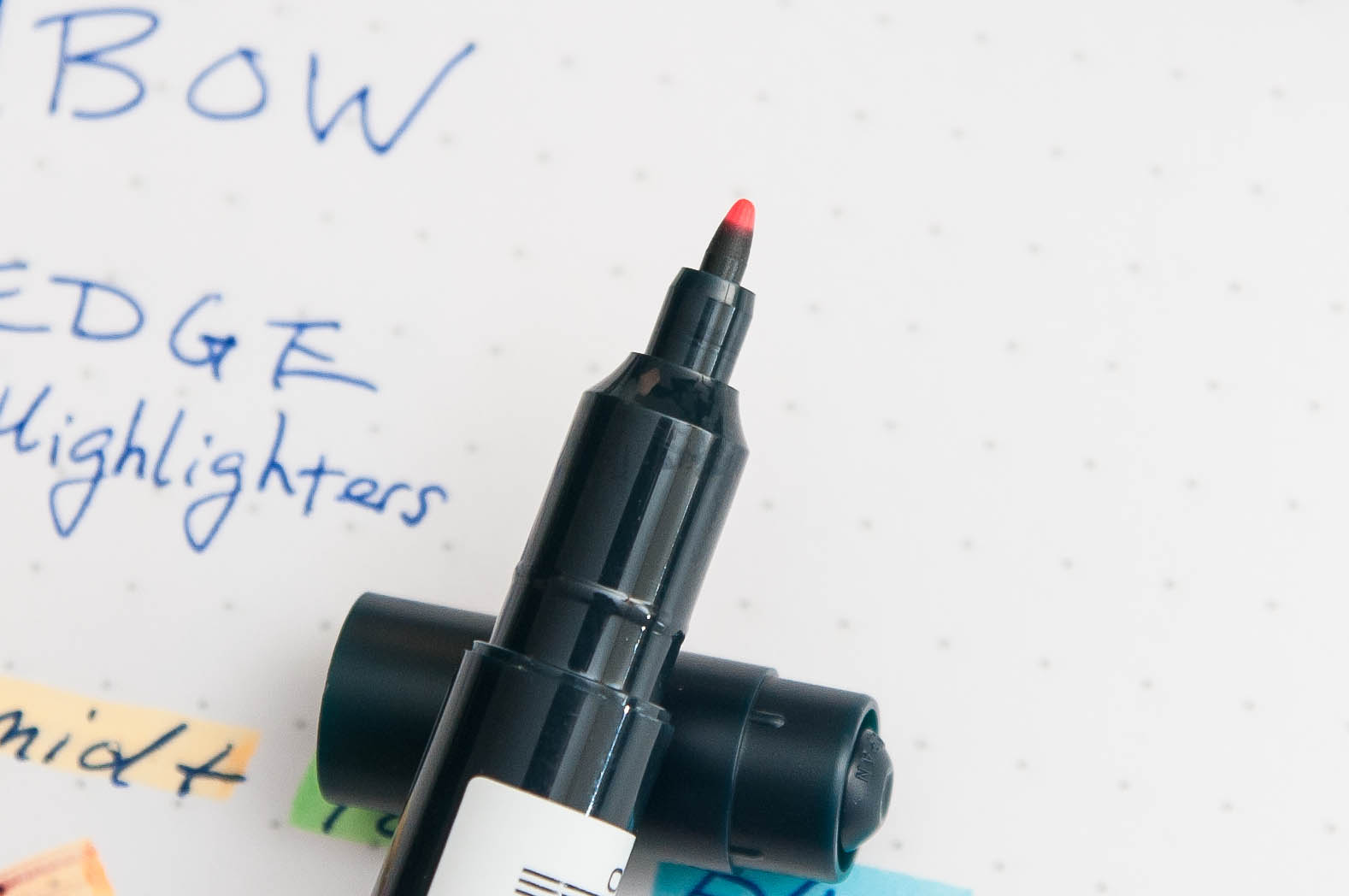
The bottom cap houses a small 0.8mm highlighter tip. In my experience, this has been great for underlining passages. This requires less ink but still does a great job of calling out the text later. The bottom tip is a plain round shape that doesn't offer much flexibility.

Both ends of every highlighter move across the page with ease, and I have had zero issues with ink delivery. On the other hand, I haven't had any bleed issues either. The tips and ink used in these pens is top notch.

Each cap can securely post onto the other cap while you use the pen. Since they're made of plastic, the pens are very lightweight, but they don't feel delicate or fragile. These have held up great in my daily carry without any other protection.

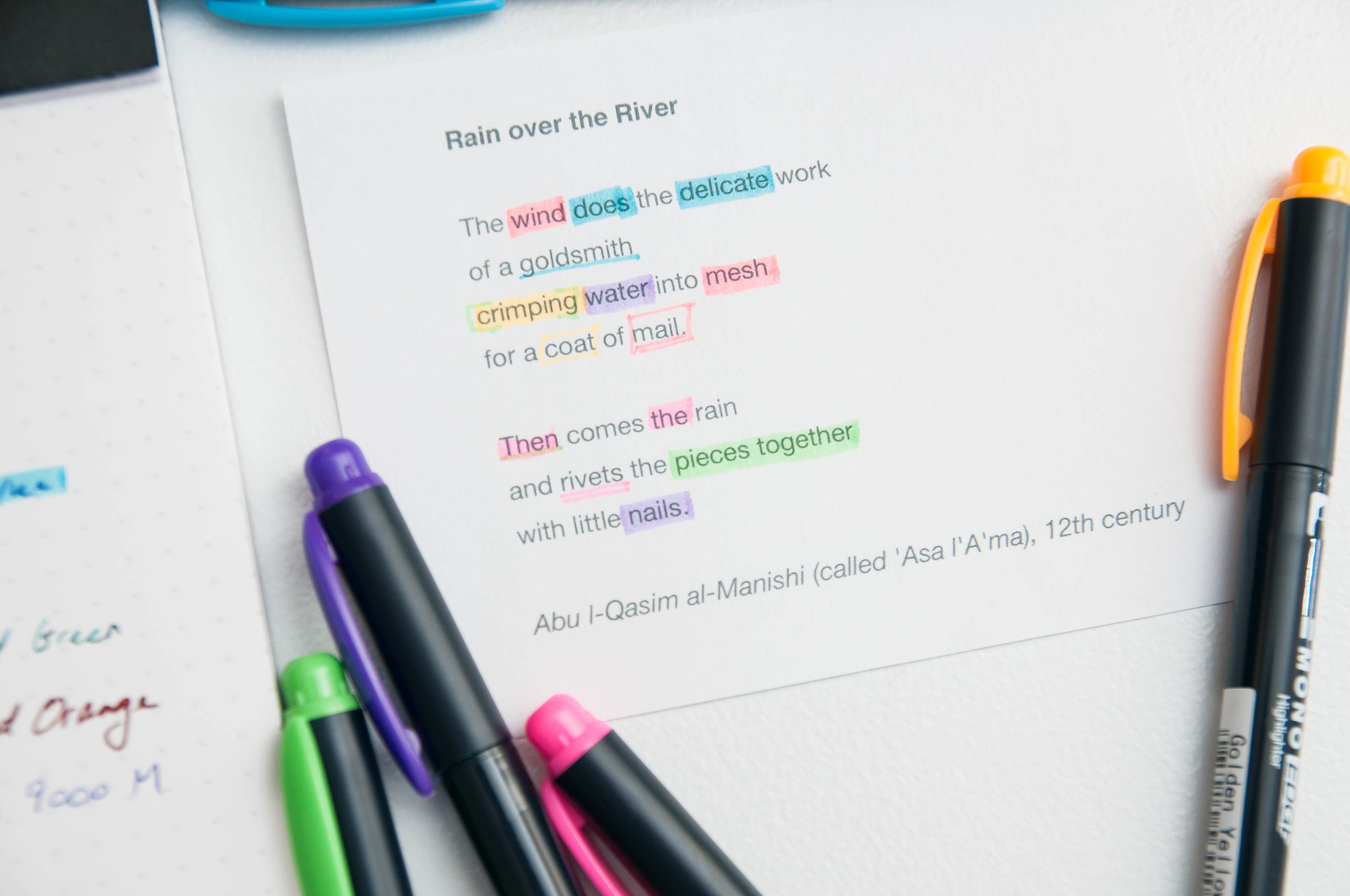
When testing these highlighters, I was pretty happy with the results. They caused bleed and smearing with most of the fountain pens I tried, but that's the nature of the inks when they mix. Anything non-water-based did fantastic.

I tried several types of paper, and it didn't make much difference with these highlighters. The short poem I used as a demonstration was printed on cheap 20# copy paper from Target, and it performed well.

Whether you're a student, artist, like keeping a journal or daily planner, or anyone who enjoys bright colors, the Tombow Mono Edge highlighters are excellent. They're also a great value. For just under $10, you get six double-tipped highlighter pens that cover the spectrum of colors. No matter your ink combo, you can find a highlighter color in this pack that contrasts well.

(JetPens provided this product at no charge to The Pen Addict for review purposes.)


Enjoy reading The Pen Addict? Then consider becoming a member to receive additional weekly content, giveaways, and discounts in The Pen Addict shop. Plus, you support me and the site directly, for which I am very grateful.

Membership starts at just $5/month, with a discounted annual option available. To find out more about membership click here and join us!

Posted on October 31, 2018 and filed under Tombow, Highlighter, Pen Reviews.

Danitrio Kama-nuri Kamakura-bori Blue Tame-nuri on Takumi Fountain Pen: A Review

(Susan M. Pigott is a fountain pen collector, pen and paperholic, photographer, and professor. You can find more from Susan on her blog Scribalishess.)

Every once in a while, you run across a pen that is so unique and so absurdly beautiful that you’ll do whatever it takes to own it. For me, that pen is the Danitrio Kama-nuri Kamakura-bori Blue Tame-nuri on Takumi (what a mouthful!) I honestly did not intend to buy another Danitrio. I owned a Sho-Hakkaku (reviewed here) that I eventually sold because I didn’t use it that often, and I found the soft stub to be too wide for my writing style (though I loved the feel of the nib). I told myself that if I found a Kama-nuri in blue, I would buy it.

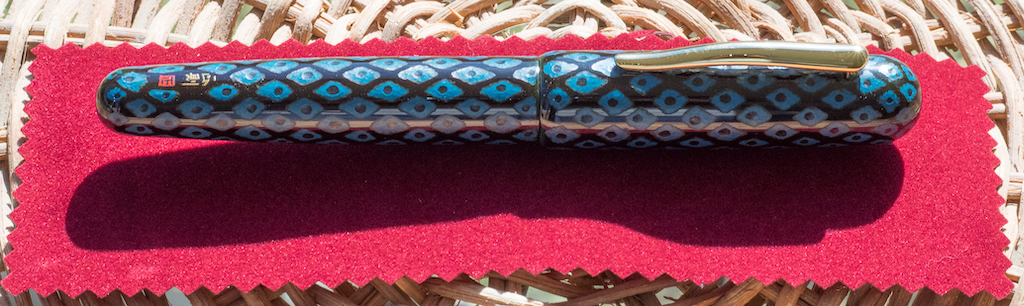
Sure enough, Bryant, at Chatterley Luxuries let me know he got some Kama-nuris in, so I went to the site and looked. My finger was poised to click on the blue Kama-nuri when I saw a pen that dazzled me. I’d never seen anything like it before. Not only was it Kama-nuri style, it was more than that--blue diamonds were carved all over the body of the pen with carved black dots in the middle of each diamond. It was more expensive than any pen I’ve ever bought (I’ll just say it was close to $2000), and I told myself, “Absolutely not.” But then I thought, “What’s the chance that you’ll ever see a pen like this again?” So I bought it, and subsequently I sold a bunch of beloved pens to cover the cost. Was it worth it? You’ll have to read the rest of the review to find out.

Considering how expensive Danitrios are, the packaging is a bit of a disappointment. My pen came in a softwood box lined in fake red velvet. Unlike Nakaya, you don’t get a kimono for your pen, and although I never use my kimonos anyway, they are a nice touch. I found no paperwork or information about the artist included in the box.

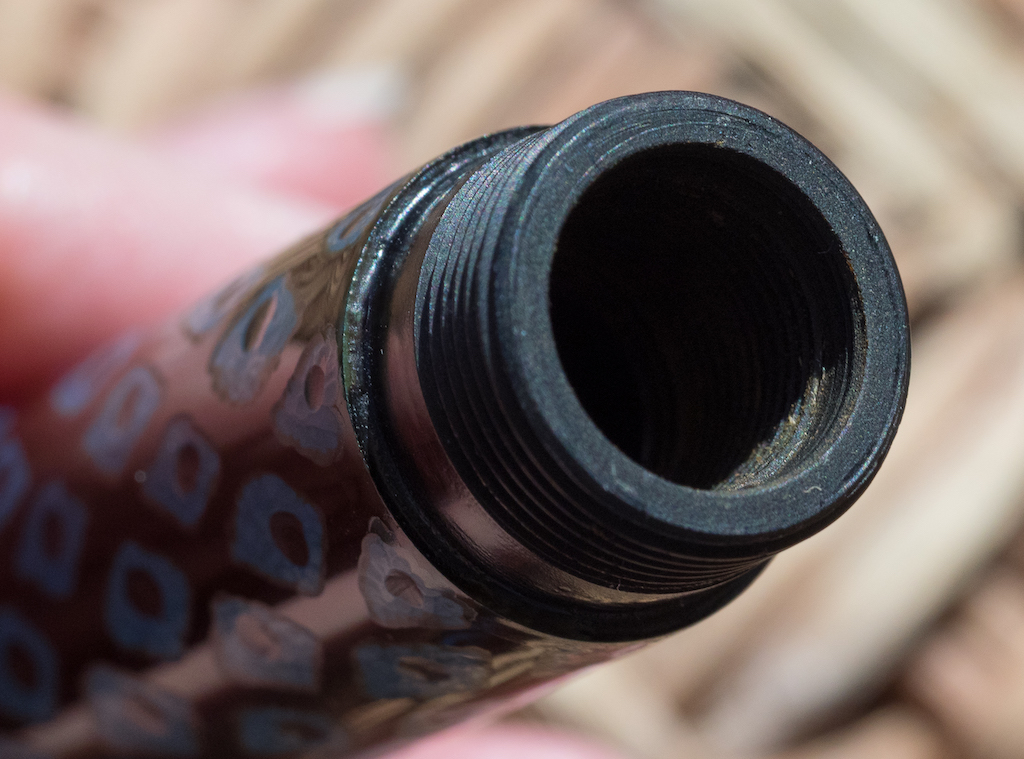
My Kamakura-bori began life as a black Urushi Takumi model. Then, the artist (Mr. Kazushi Kanego) applied layers of blue Urushi over the black. This was followed by more layers of black Urushi. Next, the artist hand-chiseled the diamond (or rhombus) pattern into the blue layer. Last he chiseled dots down into the original black layer. You can see the individual chisel marks in the macro photo below. Plus, you can see how thick the Urushi is in the second photo.

The result is a pen that is both beautiful to the eye but also tactile: you can feel the patterns with your fingers. Plus, this is no machine-made pen. The patterns are imperfect because they are done by hand. This makes the pen all the more beautiful, and it is absolutely unique.

The Takumi model is a cartridge/converter style pen, which suits me just fine. I’ve tried Danitrio’s eye-droppers and found them messy and unreliable in terms of flow (I may have just had bad luck). Sure, an eye-dropper holds more ink, but the converter is easy to use.

My pen has a gold-plated clip that is easy to manipulate. I prefer Danitrio’s painted clips, but obviously that wasn’t a deal-breaker for me.

The Takumi is a large pen, measuring 145mm/5.71 inches capped and 130mm/5.11 inches uncapped (Danitrios aren’t meant to be posted). Because it is made of Urushi, the pen is by no means heavy. It is comfortable in the hand (even though it is 16mm in diameter), and I experience no fatigue writing with it.

The #6 size, two-tone, 18k gold fine nib is perfectly proportioned for the pen. It has Danitrio’s distinctive fire logo on it. Unlike Japanese nibs, Danitrio fines are really closer to a western fine or a Japanese medium.

Unfortunately, my nib has issues. I noticed from the beginning that the nib was a bit scratchy and that it didn’t seem to write a consistently wet line. It’s been so rainy in Abilene that I had to wait quite a while for a day with enough sunlight to take macro photos of the nib. I discovered that the tines are misaligned, so that explains the problems I’m having.

I filled my pen with Sailor Yama-Dori, which is a terrific color to match the blue on the pen. When the pen is freshly inked, the nib alignment is not as noticeable, and the writing looks pretty good. But after the first few sentences, the misalignment becomes noticeable and the ink no longer flows as smoothly onto the paper. Obviously, this is a major disappointment in a pen this expensive.

So, is it worth it? Well . . . yes and no. Obviously, a pen’s worth is completely subjective. Some readers might think this pen is rather ostentatious. Others might agree with me that it is amazingly beautiful and unique. But ultimately, what matters is what I think, since I’m the one who spent the big bucks to buy it. Considering the amount of time the artist spent crafting this pen, and considering how unique the pen is, I purchased more than just a writing instrument. I purchased a piece of art that no one else on earth possesses. True, Mr. Kanego may have created other pieces with the same design, but since he hand-carved them, each pen is unique.

That said, I am disappointed with the nib. While it writes adequately, the misaligned tines definitely detract from the quality of the writing experience. I will have to send it in to get the tines realigned and the nib adjusted for better flow.

Only a few pen dealers offer Danitrios, and Chatterley Luxuries currently has the largest inventory. If you’re interested in a Kama-nuri model (all of which are hand carved), I suggest you head over to Chatterley Luxuries soon.

(I purchased this Danitrio pen with my own funds (and sold a ton of pens to pay for it!))

Posted on October 26, 2018 and filed under Danitrio, Pen Reviews.